Injection Molding Materials
We mold more than 50 engineering thermoplastics in Phoenix, from commodity ABS and polypropylene to PEEK and Ultem. Material selection is part of every quote: we match the resin to the load, temperature, chemical exposure, regulatory requirement and piece-price target, then confirm it with data sheets and samples.
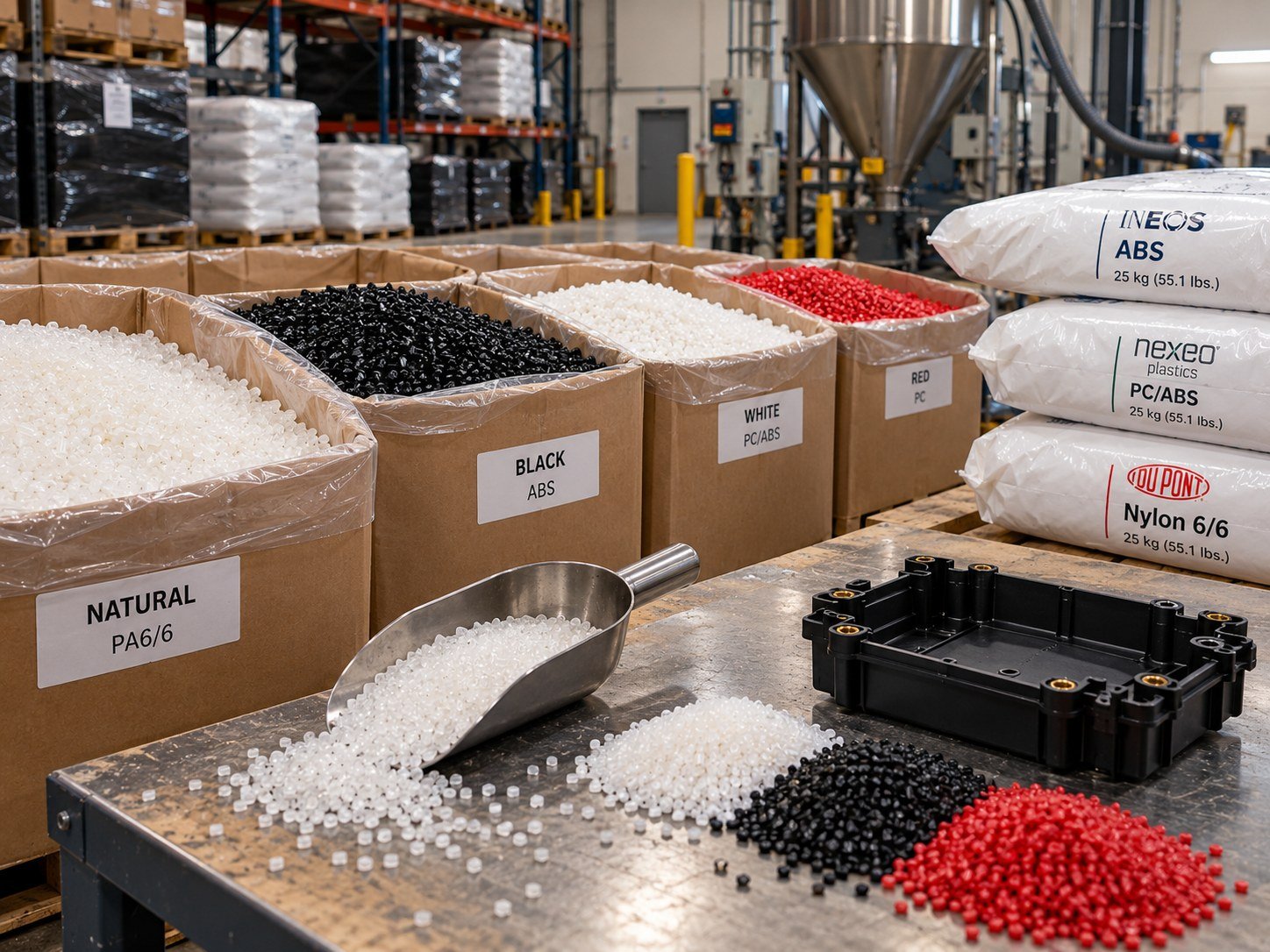
Material selection at a glance
| Material | Key properties | Typical parts | Cost tier | Notes |
|---|---|---|---|---|
| ABS | Tough, rigid, good surface finish, easy to mold | Housings, covers, consumer products | $ | Platable and paintable grades; PC/ABS blend for more heat and impact |
| Polycarbonate (PC) | High impact, optical clarity, heat to 130 °C | Lenses, guards, medical housings | $$ | Notch sensitive; UV-stabilized grades for outdoor |
| PC/ABS | Impact of PC, processability of ABS | Electronics and automotive housings | $$ | Flame-rated grades common |
| Nylon (PA6, PA66) | Strong, wear resistant, chemical resistant | Gears, bushings, connectors | $$ | Absorbs moisture; dimensions change with humidity |
| Glass-filled nylon | Stiff, dimensionally stable, high strength | Brackets, structural housings, under-hood | $$ | Abrasive on tooling; hardened steel recommended |
| Polypropylene (PP) | Chemical resistant, living hinges, low cost | Caps, containers, fluid parts | $ | Glass-filled and talc-filled grades for stiffness |
| Polyethylene (HDPE, LDPE) | Chemical resistant, flexible, low cost | Containers, liners, caps | $ | Poor bond for overmolding; low friction |
| TPE / TPU | Soft, elastic, grippy | Grips, seals, gaskets, overmolds | $$ | Match the grade to the substrate for a chemical bond |
| Acetal (POM) | Low friction, stiff, dimensionally stable | Gears, clips, snap fits | $$ | Excellent for moving parts; limited bonding |
| PEEK / Ultem (PEI) | Very high temperature, strength, chemical resistance | Aerospace, semiconductor, medical | $$$$ | High melt temperatures; hardened tooling |
| PBT | Electrical properties, heat and chemical resistance | Connectors, electrical housings | $$ | Glass-filled grades common in automotive |
| Flame-rated and ESD grades | UL 94 V-0, static dissipative | Electronics, semiconductor equipment | $$ to $$$ | Available in ABS, PC, PC/ABS, PA, PP and more |
Material families
ABS injection molding
ABS is the default resin for housings and covers: tough, rigid, inexpensive, and it takes a texture or a paint line well. It molds easily in multi-cavity tools and bonds to TPE for overmolded grips. Choose PC/ABS when the part sees heat or a drop test it would not survive in plain ABS.
Polycarbonate injection molding
Polycarbonate is the impact and clarity resin: lenses, guards, light pipes and housings that get dropped or need to be seen through. It holds up to about 130 °C. It is notch sensitive and stress-cracks in some chemicals, so radii and resin compatibility get attention in DFM. PC/ABS blends trade some clarity for easier molding and lower cost.
Nylon and glass-filled nylon injection molding
Nylon (PA6 and PA66) is the workhorse for strength, wear and chemical resistance: gears, bushings, connectors and brackets. Glass-filled nylon (13 to 50 percent) adds stiffness and dimensional stability for structural parts and under-hood components; it is abrasive, so production tools are hardened steel. Nylon absorbs moisture, which we account for in the tolerance stack and in packaging.
Polypropylene injection molding
Polypropylene is the chemical-resistant, low-cost resin for caps, containers, fluid-handling parts and anything with a living hinge. Glass- and talc-filled grades add stiffness. It is hard to bond and paint, which matters for overmolds and graphics.
Polyethylene injection molding (HDPE and LDPE)
HDPE and LDPE are chemical resistant and flexible with the lowest piece price in the catalog: containers, liners, caps and closures. Like PP they resist adhesives and most overmold bonds.
TPE and TPU injection molding
Thermoplastic elastomers and polyurethanes give you rubber-like grips, seals, gaskets and bumpers without a separate rubber process. In overmolding, the TPE grade is selected to bond chemically to the substrate (ABS, PC, PC/ABS or nylon). Durometers from very soft to semi-rigid.
Acetal (POM) injection molding
Acetal is the low-friction, high-stiffness resin for gears, clips, snap fits and sliding parts. It is dimensionally stable and resists fatigue. It does not bond or paint well, and it needs good venting in the tool.
PEEK and Ultem (PEI) injection molding
PEEK and Ultem run where nothing else survives: continuous temperatures well above 150 °C, aggressive chemicals, sterilization cycles and tight tolerances in aerospace, semiconductor and medical hardware. Melt temperatures are high, tools are hardened and heated, and piece prices reflect the resin cost. We mold both in glass- and carbon-filled grades.
Flame-rated, ESD and specialty grades
UL 94 V-0 grades of ABS, PC, PC/ABS, nylon and PP for electronics and enclosures; static-dissipative and conductive compounds for semiconductor equipment and test fixtures; UV-stabilized grades for outdoor parts; FDA and USP Class VI grades for food contact and medical use.
Choosing a material
- What loads, temperatures and chemicals will the part see in service, and for how long?
- Does it need to meet a regulatory or flame rating (UL 94, FDA, USP VI, RoHS)?
- Will it be overmolded, painted, printed, welded or bonded?
- How tight are the critical dimensions, and does moisture or temperature move them?
- What is the annual volume and the piece-price target?
Answer those five and resin selection is usually obvious. If it is not, we mold samples in two or three candidates and let the test results decide. The design guide has the property tables.
Frequently asked questions
What is the best plastic for injection molding?
There is no single best resin. ABS and polypropylene cover most housings and commodity parts; nylon and glass-filled nylon handle structural and wear applications; polycarbonate gives impact and clarity; PEEK and Ultem survive extreme heat and chemicals. We select by load, temperature, chemistry, regulatory need and cost.
Can you match a color?
Yes. We match to Pantone, RAL or a physical sample using pre-colored resin or masterbatch, and send color chips for approval before production.
Do you use recycled or regrind material?
Only when the specification allows it, at the percentage the specification allows, and never in medical, aerospace or safety-critical parts without written approval.
Can you supply material certifications?
Every shipment can include resin certifications and lot traceability back to the raw material.
Not sure which resin?
Send the part and tell us what it has to survive. We will recommend a material in the quote and mold samples if the choice is close.
Phoenix, AZ 85040
480-256-9773
b.hanke@legacy-molding.com
Mon–Fri 8:00 AM – 5:00 PM