Overmolding and Insert Molding Services
Production overmolding, insert molding and two-shot molding in Phoenix, Arizona. Soft-touch grips, seals and gaskets, PCB and cable overmolds, threaded inserts and multi-material parts, molded at volume with the same scientific process control as our standard programs.
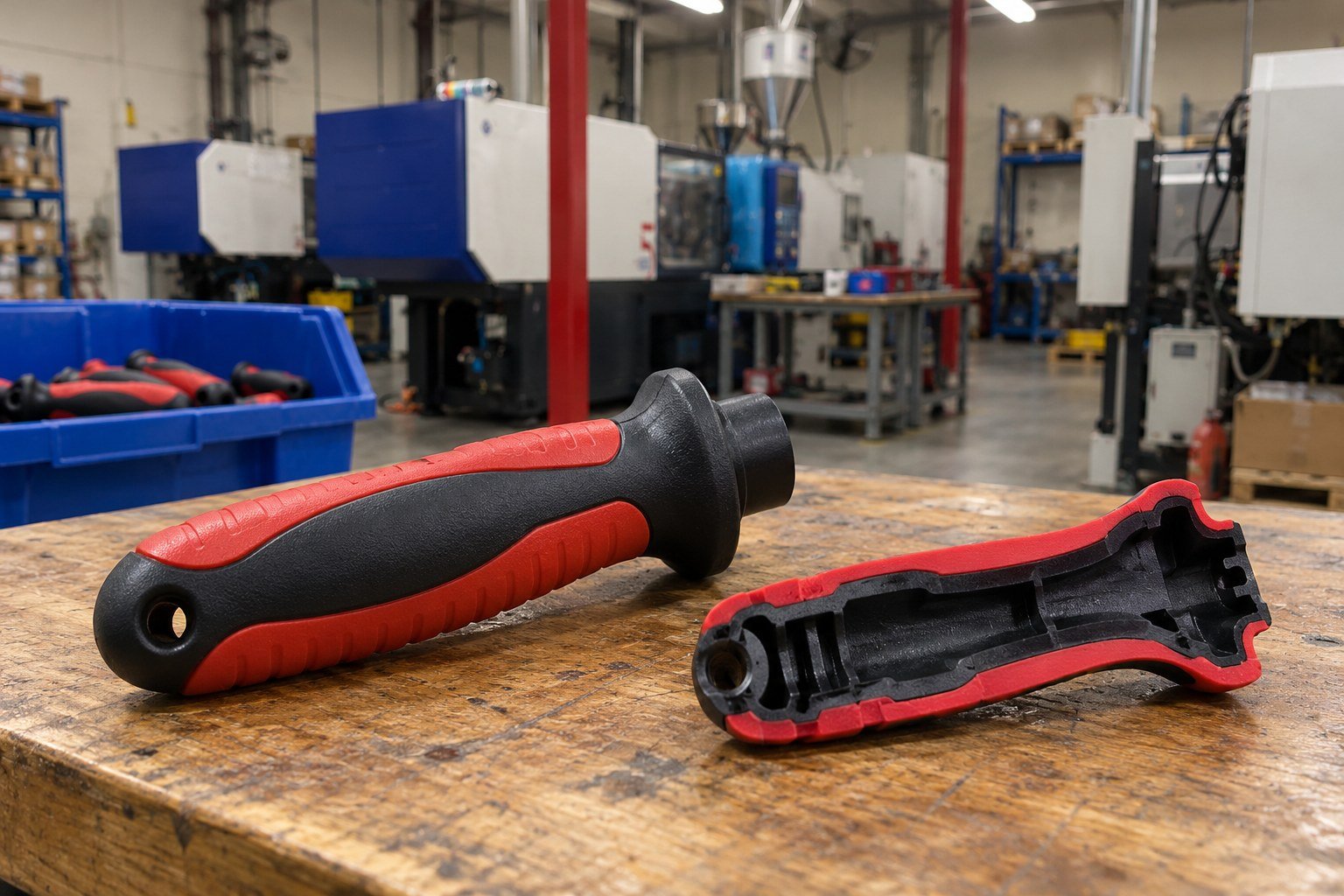
Overmolding vs insert molding
Both put two materials into one part. The difference is whether the second component is molded or placed.
| Overmolding | Insert molding | |
|---|---|---|
| What it is | A second material is molded over a molded substrate, bonding chemically or mechanically | A pre-made component (usually metal) is placed in the mold and plastic is molded around it |
| Typical parts | Soft-touch handles and grips, sealed housings, cable strain reliefs, multi-color parts, gaskets molded in place | Threaded inserts, pins and bushings, electrical contacts, encapsulated electronics, fasteners |
| Materials | Rigid substrate (ABS, PC, PC/ABS, nylon) plus TPE, TPU or a second rigid resin | Any thermoplastic around brass, steel, aluminum or molded inserts |
| Tooling | Two tools or one two-shot tool; shut-offs and bond surfaces designed in | Single tool with insert locating features; fixtured insert loading |
| Why choose it | Grip, seal, color or feel without assembly | Strength and retention without a secondary pressing operation |
Overmolding applications
Overmolding replaces an assembly step with a molding step. The soft grip on a power tool, the gasket on an enclosure, the strain relief on a cable and the two-tone housing on a consumer device are all one part when they leave our press.
- Soft-touch grips and handles (TPE or TPU over ABS, PC or nylon)
- Seals and gaskets molded in place
- PCB and cable overmolding for strain relief and sealing
- Metal-to-plastic bonds for structural parts
- Multi-color and multi-durometer consumer parts
Insert molding applications
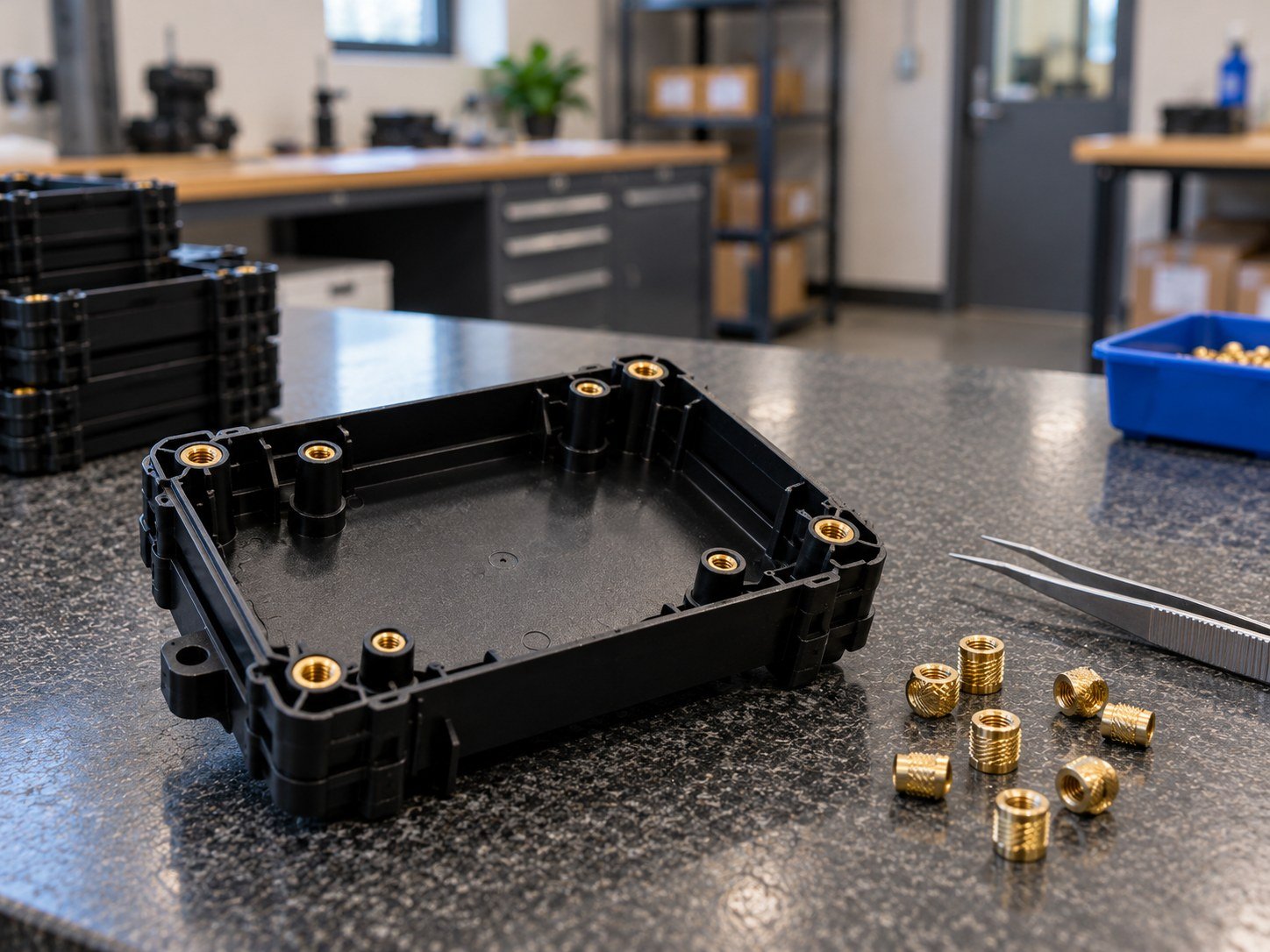
Insert molding gives a plastic part metal where it needs it: a brass thread that will not strip, a pin that carries current, a bushing that takes wear. Inserts are loaded into locating features in the tool and encapsulated in a single shot.
- Threaded brass and steel inserts
- Pins, bushings and shafts
- Electrical contacts and terminals
- Encapsulated sensors and small electronics
- Fixtured insert loading for repeatable placement
Two-shot and multi-shot molding
Two-shot injection molding (also called 2K, double-shot or multi-shot molding) molds both materials in one press cycle using a rotating or shuttling tool. Compared with overmolding in two tools it removes handling, improves bond consistency and lowers piece price at high volume, at the cost of a more complex and more expensive tool. We recommend two-shot when annual volume is high enough to amortize the tooling, usually above 100,000 parts, and overmolding in separate tools when it is not.
| Substrate | Overmold | Bond | Typical use |
|---|---|---|---|
| ABS | TPE | Chemical | Grips, bumpers |
| Polycarbonate | TPU | Chemical | Housings with seals |
| Nylon (PA6/66) | TPE (PA-compatible) | Chemical | Tool handles |
| PC/ABS | TPE | Chemical | Electronics housings |
| Polypropylene | TPV | Chemical | Living-hinge parts with grip |
| Any rigid resin | Dissimilar resin | Mechanical (undercuts, through-holes) | When no chemical bond exists |
Design considerations
- Design shut-offs so the second material cannot flash onto the substrate
- Give the bond surface area and texture; a mechanical lock where chemistry will not do it
- Hold inserts on their own features, not on the plastic, so they do not shift under injection pressure
- Gate the overmold so it fills from thick to thin and does not wash the substrate
- Account for two shrink rates in the tolerance stack
The design guide covers all five in detail, with diagrams.
Frequently asked questions
What is the difference between overmolding and insert molding?
Overmolding molds a second plastic over a molded substrate. Insert molding molds plastic around a pre-made component, usually metal, that is placed in the tool. Overmolding is about feel, seal and color; insert molding is about strength and retention.
Is two-shot molding cheaper than overmolding?
Per part, usually yes at high volume, because it removes handling and a second press. The two-shot tool costs more, so the break-even is typically above 100,000 parts a year.
Which materials bond in overmolding?
TPE and TPU bond chemically to ABS, PC, PC/ABS and nylon when the grades are matched. Dissimilar rigid resins and polyolefins usually need a mechanical lock. We select bonding grades during DFM.
Can you overmold electronics?
Yes. Low-pressure and standard overmolding of PCBs, sensors and cable assemblies for strain relief and sealing is a common program for us.
Quote an overmolded or insert-molded part
Send the CAD, the insert drawing if there is one, and the annual volume. We will recommend overmold, insert or two-shot and price it.
Phoenix, AZ 85040
480-256-9773
b.hanke@legacy-molding.com
Mon–Fri 8:00 AM – 5:00 PM